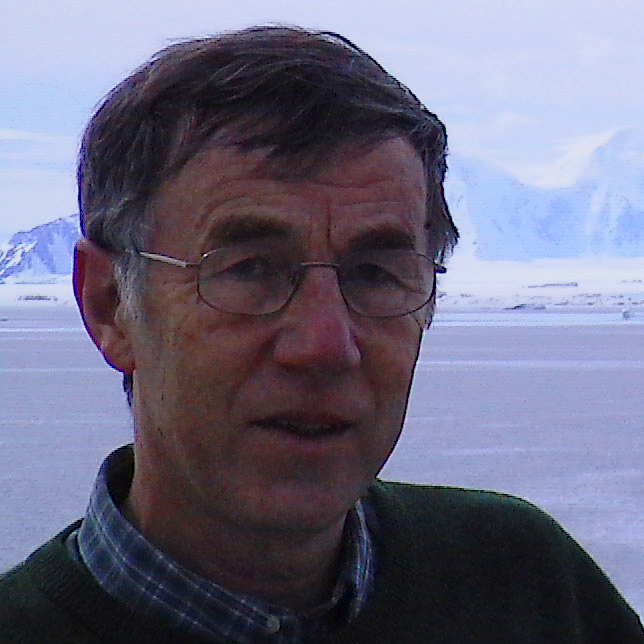
 Dr David J. Webb
Dr David J. Webb
Dr David J. Webb
National Oceanography Centre, Southampton, U.K.
Position: Emeritus Fellow
Group: Marine Systems Modelling
NOC Page: https://noc.ac.uk/n/David+Webb
This project has involved analysing data from a high resolution global ocean model with the aim of obtaining a better understanding of the oceanic processes involved in the development of El Niños.
The main paper resulting from this study is Webb (2018a). There have also been two technical reports. These are Webb (2018b) and Webb (2016). A video of a seminar summarising the study is available on YouTube(★★★?).
The 2018 paper analysed model results for periods including the strong El Niños of 1982-1983 and 1997-1998. It showed that during the development of these El Niños, the transport of warm water in the Pacific was dominated by the North Equatorial Counter Current (NECC). The results also indicated a number of physical mechanisms responsible for the increased heat transport during the El Niño.
The follow-up paper (Webb, Coward and Snaith, 2020) compares key aspects of the model with satellite radar altimeter and sea surface temperature measurements during the 1995-2000 period. This failed to find any significant error in the model results giving further confidence to the results and hypotheses put forward in the 2018 paper.
The most recent paperr (Webb, 2021) investigates the cause of the drop of sea level in the North Equatorial Trough prior to strong El Niños. It finds that this is due to Ekman pumping resulting from the local winds. The study also finds that this is a necessary but not sufficient condition for the triggering of strong El Niños.
Before becoming involved in the El Niño study I wrote a series of papers on continental shelf resonances which affect the tides and result in the dissipation of large amounts of tidal energy.
The first of these papers was Webb (2012), on the Gulf of Carpentaria, followed by Webb (2013a) on the resonances of the English Channel and the Irish Sea and Webb (2014a) on the resonances of Hudson Bay and Hudson Strait.
The Hudson Bay and Hudson Strait region is of particular interest, first, because it absorbs almost half the energy of the semi-diurnal tide in the North Atlantic and, secondly, because it acts almost like a black hole, absorbing at some frequencies over 90% of the incident tidal energy.
Webb, David J. (2020) On the low western Pacific sea levels observed prior to strong East Pacific El Niños. Ocean Science, 17, 1585-1604 . https://doi.org/10.5194/os-17-1585-2021
Webb, David J.; Coward, Andrew C.; Snaith, Helen M. (2020) A comparison of ocean model data and satellite observations of features affecting the growth of the North Equatorial Counter Current during the strong 1997–1998 El Niño. Ocean Science, 16 (3), 565-574. https://www.ocean-sci.net/16/565/2020/
Webb, David. (2018a) On the role of the North Equatorial Counter Current during a strong El Niño. Ocean Science, 14 (4), 633-660. https://doi.org/10.5194/os-14-633-2018
Rye, Craig D.; Naveira Garabato, Alberto C.; Holland, Paul R.; Meredith, Michael P.; Nurser, A.J. George; Hughes, Chris W.; Coward, Andrew C.; Webb, David J. (2014) Rapid sea-level rise along the Antarctic margins in response to increased glacial discharge. Nature Geoscience, 7 (10) 732-735. 10.1038/ngeo2230
Webb, D.J. (2014a) On the tides and resonances of Hudson Bay and Hudson Strait. Ocean Science, 10 (3), 411-426. 10.5194/os-10-411-2014
Webb, D.J. (2013a) On the shelf resonances of the English Channel and Irish Sea. Ocean Science, 9 (4), 731-744. 10.5194/os-9-731-2013
Huerta-Casas, A.M.; Webb, D.J. (2012) High frequency fluctuations in the heat content of an ocean general circulation model. Ocean Science, 8 (5), 813-825. 10.5194/os-8-813-2012
Webb, D.J. (2012) On the shelf resonances of the Gulf of Carpentaria and the Arafura Sea. Ocean Science, 8 (5), 733-750. 10.5194/os-8-733-2012
Humphries, U.W.; Webb, D.J. (2008) On the Indonesian Throughflow in the OCCAM 1/4 degree ocean model. Ocean Science, 4 (3). 183-198.
Jia, Y.; Coward, A.C.; de Cuevas, B.A.; Webb, D.J.; Drijfhout, S.S. (2007) A model analysis of the behavior of the Mediterranean Water in the North Atlantic. Journal of Physical Oceanography, 37 (3), 764-786. 10.1175/JPO3020.1
Levine, Richard C.; Webb, David J. (2007) On available energy in the ocean and its application to the Barents Sea. Ocean Science Discussions, 4 (6). 897-931.
Webb, David J.; de Cuevas, Beverly A. (2007) On the fast response of the Southern Ocean to changes in the zonal wind. Ocean Science, 3, 417-427. 10.5194/os-3-417-2007
Webb, D.J.; de Cuevas, B.A. (2003) On the region of large sea surface height variability in the southeast Pacific Ocean. Journal of Physical Oceanography, 33 (5), 1044-1056. 10.1175/1520-0485(2003)033<1044:TROLSS>2.0.CO;2
Webb, D.J.; de Cuevas, B.A. (2002a) An ocean resonance in the southeast Pacific. Geophysical Research Letters, 29 (8). art.1252-[3]. 10.1029/2001GL014259
Webb, D.J.; de Cuevas, B.A.. (2002b) An ocean resonance in the Indian sector of the Southern Ocean. Geophysical Research Letters, 29 (14). art.1664-[3p].10.1029/2002GL015270
Webb, D.J.; Suginohara, N. (2001) Vertical mixing in the ocean. Nature, 409 (6816). p37. 10.1038/35051171
Fox, A.D.; Haines, K.; de Cuevas, B.A.; Webb, D.J. (2000) Altimeter assimilation in the OCCAM global model Part II: TOPEX/POSEIDON and ERS-1 assimilation. Journal of Marine Systems, 26 (3/4), 323-347. 10.1016/S0924-7963(00)00044-0
Fox, A.D.; Haines, K.; de Cuevas, B.A.; Webb, D.J. (2000) Altimeter assimilation in the OCCAM global model Part I: a twin experiment. Journal of Marine Systems, 26 (3/4), 303-322. 10.1016/S0924-7963(00)00043-9
Griffies, S.M.; Boning, C.; Bryan, F.O.; Chassignet, E.P.; Gerdes, R.; Hasumi, H.; Hirst, A.; Treguier, A-M.; Webb, D. (2000) Developments in ocean climate modelling. Ocean Modelling, 2 (3/4), 123-192. 10.1016/S1463-5003(00)00014-7
Webb, D.J. (2000) Evidence for shallow zonal jets in the South Equatorial Current region of the southwest Pacific. Journal of Physical Oceanography, 30 (4), 706-720. 10.1175/1520-0485(2000)030<0706:EFSZJI>2.0.CO;2
Webb, D.J. (1999) An analytic model of the Agulhas Current as a western boundary current with linearly varying viscosity. Journal of Physical Oceanography, 29(7), 1517-1527.
Webb, D.J., de Cuevas, B., Richmond, C. (1998) Improved advection schemes for ocean models. Journal of Atmospheric and Oceanic Technology, 15, 1171-1187.
Webb, D.J., Coward, A.C., de Cuevas, B., Gwillam, C. (1997) A multi-processor ocean general circulation model using message passing. Journal of Atmospheric and Oceanic Technology, 14 (1), 175-183.
Webb, D.J. (1996) An ocean model code for array processor computers. Computers and Geosciences, 22(5), 569-578.
Wefer, G., Berger, W.H., Siedler, G., Webb, D.J. (Eds) (1996) 'The South Atlantic', Springer, Berlin, 644pp.
Lutjeharms, J.R.E., and Webb, D.J. (1995) Modelling the Agulhas Current system with FRAM (Fine Resolution Antarctic Model). Deep-Sea Research, 42(4), 523-551.
Webb, D.J. (1995) The vertical advection of momentum in Bryan-Cox-Semtner ocean general circulation models. Journal of Physical Oceanography, 25(12), 3186-3195.
Lutjeharms, J. R. E., D. J. Webb, B. A. de Cuevas and S Thompson (1996) Large-scale modelling of the South-East Atlantic upwelling system. South African Journal of Marine Science, 16: 205-225.
Doos, Kristofer; Webb, David. (1994) The Deacon Cell and the other meridional cells of the Southern ocean. Journal of Physical Oceanography, 24 (2), 429-442. 10.1175/1520-0485(1994)024<0429:TDCATO>2.0.CO;2
Webb, David J. (1993) A simple model of the effect of the Kerguelen Plateau on the strength of the Antarctic Circumpolar Current. Geophysical and Astrophysical Fluid Dynamics, 20 (1-4), 57-84. 10.1080/03091929308203587
Killworth, P.D., Stainforth, D., Webb, D.J. & Paterson, S.M. (1991) The development of a free surface Bryan-Cox-Semtner ocean model. Journal of Physical Oceanography, 21, 1333-1348.
Webb, D.J., Killworth, P.D., Coward A., and Thompson, S. (1991) The FRAM Atlas of the Southern Ocean. Natural Environment Research Council, Swindon, 67pp.
Carter, D.J., Foale, S. & Webb, D.J. 1991. Variations in Global wave height throughout the year. International Journal of Remote Sensing, 12(8), 1687-1697.
The FRAM Group (Webb, D.J. et al) 1991. An Eddy-Resolving Model of the Southern Ocean. EOS, Transactions, American Geophysical Union, 72(15), 169-174.
Lutjeharms, J.R.E., Webb, D.J., and B.A de Cuevas, (1991) Applying the Fine Resolution Antarctic Model (FRAM) to the ocean circulation around southern Africa. South African Journal of Science, 87, 346-349.
Challenor, P.G., Foale, S. & Webb, D.J. (1990) Seasonal changes in the global wave climate measured by the Geosat altimeter. International Journal of Remote Sensing, 11 (12), 2205-2213.
Webb, D.J. and Moore, A., 1986 Assimilation of Altimeter Data into Ocean Models. Journal of Physical Oceanography, 16 (11), 1901-1913.
Webb, D.J. and Morris, R.J. (1984) DSDP Site 258: evidence for recent nutrient-rich upwelling off western Australia. Deep-Sea Research, 31(10), 1265-1272.
Webb, D.J. (1982) Tides and the evolution of the Earth-Moon system. Geophysical Journal of the Royal Astronomical Society, 70, 261-271.
Webb, D.J. (1982) The effect of polar wander on the tides of a hemispherical ocean. Geophysical Journal of the Royal Astronomical Society, 68, 689-707.
Webb, D.J. (1981) Numerical Model of the Tides in the Gulf of Carpenteria and the Arafura Sea. Australian Journal of Marine and Freshwater Research, 32, 31-44.
Webb, D.J. (1981) A comparison of SEASAT 1 altimeter measurements of wave height with measurements made by a pitch-roll buoy. Journal of Geophysical Research, 86, 6394-6398.
Webb, D.J. (1981) Remote Sensing of the Oceans. Nature, 289, 120-121.
Webb, D.J. (1980) Tides and tidal friction in a hemispherical ocean centred at the equator. Geophysical Journal of the Royal Astronomical Society, 61, 573-600.
Webb, D.J. (1978) Non-linear transfers between sea waves. Deep-Sea Research, 25, 279-298.
Webb, D.J. (1976) Patterns in the Equilibrium Tide and the Observed Tide. Australian Journal of Marine and Freshwater Research, 27, 617-632.
Austin, R.H., Phillips, B.F. and Webb, D.J. (1976) A method for calculating moonlight illuminance at the Earth's surface. Journal of Applied Ecology, 13, 741-748.
Webb, D.J. (1976) A model of continental-shelf resonances. Deep-Sea Research, 25, 1-15.
McMurtree, R. and Webb, D.J. (1975) Tidal response functions around Australia from Harmonic Constants. Australian Journal of Marine and Freshwater Research, 26, 245-269.
Webb, D.J. (1974a) Green's Function and Tidal Prediction. Reviews of Geophysics and Space Physics, 12(1), 102-116.
Webb, D.J. (1974b) The Statistics of Relative Abundance and Diversity. Journal of Theoretical Biology, 43, 277-291. (Revised version).
Webb, D.J. (1973) Tidal Resonance in the Coral Sea. Nature, 243 (5409), p511.
Webb, D.J., 1972. On the age of the semi-diurnal tide. Deep-Sea Research, 20, 847-852.
Webb, D.; Suginohara, N. (2001) The interior circulation of the ocean. In: Siedler, G.; Church, J.; Gould, J., (eds.)Ocean Circulation and Climate: Observing and Modelling the Global Ocean. San Fransisco CA, USA, Academic Press, 205-214, 736pp. (International Geophysics Series, 77).
de Cuevas, B.A., Webb, D.J., Coward, A.C., Richmond, C.S. and Rourke, E., (1999) The UK Ocean Circulation and Climate Advanced Modelling Project (OCCAM). Pp 325-336 in "High Performance Computing", (Eds: Allan, R.J., Guest, M.F., Simpson, A.D., Henty, D.S. and Nicole, D.A..) Kluwer Academic, New York, 681 pp.
Richmond, C.S., Coward, A.C., de Cuevas, B.A., Rourke, E. and Webb, D.J. (1998) Modelling the Global Ocean Circulation on the T3D. Pp 649-658 in "Parallel Computational Fluid Dynamics: Proceedings of the Parallel CFD '97 Conference, Manchester, U.K.", (Eds: Emerson, D.R., Ecer, A., Periaus, J., Satofuka, N.). Elsevier, Amsterdam, 681 pp.
Gwilliam, C.S., Coward, A.C., de Cuevas, B.A., Webb, D.J., Rourke, E., Thompson, S.R., Doos, K. (1997) The OCCAM Global Ocean Model. Pp 24-30 in, Numerical Simulations in the Environmental and Earth Sciences: Proceedings of the Second UNAM-Cray Supercomputing Conference, (Eds. Garcia-Garcia, F., Cisneros, G., Fernandez-Eguiarte, A., Alvarez, R.). Cambridge University Press, 283 pp.
Webb, D.J. (1996) The Southern Boundary of the South Atlantic. Pp 211-217 in 'The South Atlantic', Eds Wefer, G., Berger, W.H., Siedler, G., Webb, D.J.. Springer, Berlin, 644pp.
Gwilliam, C.S., Coward, A.C., de Cuevas, B.A., Webb, D.J., Rourke, E. (1996) The OCCAM Global Ocean Model: Current status and future plans within the UK Oceanographic Community. Pp 1-10 in: Proceedings of the First Annual Meeting MMarie (Applications of High Performance Computing Techniques for the Modelling of Marine Ecosystems), Cagliari, 18-19 January 1996. Ed: L Beernaert. Dept of Computer Science, Katholieke Universiteit Leuven, Leuven, Belgium.
Webb, D.J. (1995) The circulation of the southern ocean: the new insights coming from the analysis of FRAM. Pp 30-31, in: A review of supercomputing 1991-1994, ed: Wall, A. Engineering and Physical Sciences Research Council, Swindon. 40 pp.
Snaith, H.M. and Webb, D.J., 1993. Comparisons of ERS-1 altimeter height data and the Fine Resolution Antarctic Model (FRAM). Proceedings First ERS-1 Symposium - Space at the Service of our Environment, Cannes, France, 4-6 November 1992, ESA SP-359, pp 141-146.
Webb, D.J., 1991. On 'Earth's rotation from eons to days, Edited by P Broche and J Sundermann, Springer-Verlag, Berlin, 1990'. Geophysical Journal International, 105, 807-808.
Webb, D.J. (1991) Results from FRAM - the Fine Resolution Antarctic Model. Pp 84-92 in: GLOBEC: Southern Ocean Program, GLOBEC Workshop on Southern Ocean Marine Animal Populations and Climate Change, eds E. Hofmann, M.E. Huntley. GLOBEC Report No 5. JOI Inc, Washington. 150pp.
Webb, D.J. 1991. FRAM - The Fine Resolution Antarctic Model. p 1-14 in: Farmer, D.G. & Rycroft, M.J. (eds.) Proceedings of conference on 'Computer Modelling in the Environmental Sciences'. Keyworth, April 1990. Clarendon Press, Oxford, pp 379.
Webb, D.J. and King, B.A., 1989. Preliminary results from Charles Darwin Cruise 34A in the western equatorial Pacific. Pp165-172 in: Proceedings western Pacific international meeting and workshop on TOGA COARE. Eds: Picaut, J., Lukas, R. and Delcroix, T.. ORSTOM, Noumea, 833pp
Webb, D.J. 1989a. Assimilation of data into ocean models. pp233-249 in: Ocean Circulation Models: Combining Data and Dynamics, (eds. Anderson, D.L.T. & Willebrand J.). Kluwer Academic Publishers, Dordrecht, 605pp.
Webb, D.J. 1989a. The assimilation of satellite altimeter data into ocean models. pp 269-278 in: Mathematics in Remote Sensing, (ed. Brooks, S.R.). Clarendon Press, Oxford, pp399.
Webb, D.J., 1983. Wave measurements with the SEASAT radar altimeter - a review. Chapter 25 of: Satellite Microwave Remote Sensing, ed. J.Allen.
Webb, D.J., 1982. Tides and Tidal energy. Contemporary Physics, 23 (5), 419-442.
Webb, D.J., 1978. The wave-wave interaction machine. P335-343, in: 'Turbulent fluxes through the sea surface, wave dynamics and prediction', eds. A. Favre and K. Hasselmann. Plenum press, New York. 677pp.
Webb, D.J., 1983. On the reduction of tidal dissipation produced by increases in the Earth's rotation rate and its effect on the long term history of the Moon's orbit. p 210-221 in: Tidal friction and the Earth's rotation II, ed. P. Brosche and J. Sundermann. Springer-Verlag, Berlin. 345pp.
Webb, David. (2018b) A note on Stommel′s Theory of the Tropical Cell. Southampton, National Oceanography Centre, 15pp. (National Oceanography Centre Research and Consultancy Report, 63)
Webb, D.J. (2016) A comparison of sea surface temperatures in the Equatorial Pacific Nino regions with results from two early runs of the NEMO 1/12° Ocean Model. Southampton, National Oceanography Centre, 31pp. (National Oceanography Centre Research and Consultancy Report, 55)
Webb, D.J. (2014b) On the adjoint of Laplace′s tidal equations. Southampton, National Oceanography Centre, 27pp. (National Oceanography Centre Internal Document, 07)
Webb, D.J. (2013b) On the impact of a radiational open boundary condition on continental shelf resonances. Southampton, National Oceanography Centre, 7pp. (National Oceanography Centre Internal Document, 06)
Huerta-Casas, A.M.; Webb, D.J. (2011) High frequency fluctuations in the heat content of an ocean general circulation model. Southampton, National Oceanography Centre, 24pp. (UNSPECIFIED) (Unpublished)
Webb, D.J. (2011a) Notes on a 1-D model of continental shelf resonances. Southampton, UK, National Oceanography Centre Southampton, 14pp. (National Oceanography Centre Southampton Research and Consultancy Report 85)
Webb, D.J. (2011b) On the shelf resonances of the Gulf of Carpentaria and the Arafura Sea. Southampton, UK, National Oceanography Centre Southampton, 18pp. (National Oceanography Centre Southampton Research and Consultancy Report 84)
Church, J.; Webb, D.; de Cuevas, B.. (2001) Improving understanding and prediction of climate variability and change in the Australian region. AVISO Altimetry Newsletter, No. 8. 38-40.
Webb, D.J. (1999) OCCAM on the T3D: a new view of the global ocean. High Performance Computing, 10, 6-8. (Published by the Edinburgh parallel Computing Centre at the University of Edinburgh).
Bryden, H.L. and D.J. Webb, (1999) A perspective on the need to build a dam across the Strait of Gibraltar. EGS Newsletter, 69, 1-3.
Webb, D.J. (1993) An ocean model code for array processor computers. Institute of Oceanographic Sciences, Internal Report No. 324.
Webb, D.J., (1992) The equation of state algorithms used by the FRAM model. IOSDL Internal Document No. 313. 34pp.
King, B.A.; Allison, M.; Alderson, S.G.; Read, J.F.; Smithers, J.; Webb, D.J. (1991) SeaSoar data from the western equatorial Pacific Ocean, collected on RRS Charles Darwin Cruise 34A, September 1988. Wormley, UK, Institute of Oceanographic Sciences Deacon Laboratory, 89pp. (Institute of Oceanographic Sciences Deacon Laboratory Report 291)
Webb, D.J., de Cuevas, B.A., Killworth, P.D. & Rowe, M. (1990) Initial results from a fine resolution model of the Southern Ocean. Institute of Oceanographic Sciences Deacon Laboratory. Internal Document No 293, 14pp.
Killworth, P.D.; Stainforth, D.; Webb, D.J.; Paterson, S.M. (1989) A free surface Bryan-Cox-Semtner model. Wormley, UK, Institute of Oceanographic Sciences Deacon Laboratory, 184pp. (Institute of Oceanographic Sciences Deacon Laboratory Report 270)
Webb, D.J. (1989) RRS Charles Darwin Cruise 34A, 15 August - 30 September 1988. Near surface physical oceanography and meteorology of the western equatorial Pacific. Wormley, UK, Institute of Oceanographic Sciences Deacon Laboratory, 34pp. (Institute of Oceanographic Sciences Deacon Laboratory Cruise Report 207)
Killworth, P.D., Stainforth, D., Webb, D.J. & Paterson, S.M. (1989) A Free-Surface Bryan-Cox_Semtner Model. IOSDL Report No 270, 184pp.
Webb, D.J. and King, B.A. (1989) Preliminary results from Charles Darwin Cruise 34A in the western equatorial Pacific. Pp165-172 in: Proceedings western Pacific international meeting and workshop on TOGA COARE. Eds: Picaut, J., Lukas, R. and Delcroix, T.. ORSTOM, Noumea, 833pp
Webb D.J. (1989) RRS Charles Darwin Cruise 34A, 15 August - 30 September 1988. The near surface physical oceanography and meteorology of the western equatorial Pacific. IOSDL Cruise Report, No.207, 34pp.
Webb, D.J. (1984) On the importance of the background potential vorticity field. Ocean Modelling, 58, 5-7.
Webb, D.J. (1981) The Semtner Programs. User Note 1, Natural Enviroment Research Council, Oceanic Modelling Group. 13pp.
Webb, D.J. (1981) Plotting for the Semtner models. User Note 2, Natural Enviroment Research Council, Oceanic Modelling Group. 20pp.
Webb, D.J. (1979) A comparison of satellite and sea surface measurements of significant wave height. Wormley, UK, Institute of Oceanographic Sciences, 8pp. (Institute of Oceanographic Sciences Report 85)
Tranter, J. and Webb, D.J., 1975. Rossby-wave simulation of Sofar float tracks. MODE Hot Line News, 75, 1-4.
Gould, J., Swallow, J., and Webb, D.J., 1975. First field phase of the I.O.S. topographic experiment. Mode Hot Line News. 74, 1-2.
Gould, J., Hendry, R., Huppert, H., and Webb, D.J., 1975. I.O.S. Topographic Cruise Leg 2. Mode Hot Line News, 82, 1-3.
Webb, David J and Johnson J. (2004) Ocean Science: New Open Access EGU Journal. The Eggs, 10, 3-4.
Jia, Y.; Coward, A.C.; de Cuevas, B.A.; Webb, D.J. (2002) The Mediterranean overflow and its influence on the North Atlantic circulation in a global ocean model (abstract of paper presented at ASLO/AGU Ocean Sciences Meeting, Honolulu, HI, 11-15 Feb 2002). EOS: Transactions American Geophysical Union, 83 (4 Supplement). p.OS235.
Webb, D.. 2001 Book review: Numerical models of oceans and oceanic processes. By L.H. Kantha & C.A. Clayson. Academic, 2000. 940 pp. ISBN 0124340687. $129.95. Journal of Fluid Mechanics, 432. p.442.
Webb, D.J. (1997) Review of "Wunsch, C, 1996: The Ocean Circulation Inverse Problem, Cambridge University Press, Cambridge, New York, Melbourne, 442 pp". Geophysical Journal International, 130, 548.
Webb, D.J. (1996) Review of "Tsunamis: 1992-1994. Their Generation, Dynamics and Hazard, Kenji Satake, Fumihiko Imamura (eds), Birkhäuser verlag, Basel, 1995, 890pp". Geophysical Journal International, 126, 300.
Webb, D.J. (1994) Review of 'Large eddy simulations of complex engineering and geophysical flows, Eds: Galperin, B. and Orszag, S.A.'. Geophysical Journal, 1602.
Webb, D.J. (1994) Review of: 'Hydrographic Atlas of the Southern Ocean' by Olbers, D., Gouretski, V., Seiß, G. and J. Schröter. Antarctic Science, 6 (4), 543-544..
Webb, D.J. (1994) Modelling the ocean. The Globe, 21, 3-4.
Webb, D.J. 1990. The Fine Resolution Antarctic Model. NERC News 14, 28-31.
Webb, D.J. (1984) Review of 'Ocean Tides (Mathematical Models and Numerical Experiments) by Marchuk, G.I. and Kagan, B.A.'. Deep-Sea Research
Webb, D.J. (1981) Tides and the evolution of the earth-Moon system. Ocean Modelling, 39, 5-6.
Webb, D.J. (1981) The effect of polar wander on the tides of a hemispheric ocean. Ocean Modelling, 36, 8-9.
Webb, D.J. (1981) Linear oceans. A review of 'Waves in the Ocean', by P.H. Leblond and L.A. Mysak. Nature, 274, p724.
Webb, D.J. (1978) Ocean wave theories. A review of 'The Dynamics of the Upper Ocean. (Second Edition)', by O.M. Phillips. Nature, 274, p194.
WOCE International Project Office (Webb, D.J. as chairman of Numerical Experimentation Group) (1991) Numerical Experimentation Group, Report of the fifth meeting, NEG-5. WOCE Report No 59/91. WOCE International Project Office, Wormley, U.K., 20pp.
WOCE International Project Office (Webb, D.J. as chairman of Numerical Experimentation Group) (1991) Workshop on Global Ocean Modelling. WOCE Report No 60/91. WOCE International Project Office, Wormley, U.K., 20pp.
WCRP Steering Group on Global Climate Modelling (Webb D.J. as member of steering group) (1991) Global Climate Modelling: Report of first session of WCRP Steering Group on Global Climate Modelling (Geneva, 5-8 November 1990). WMO World Climate Research Program, WCRP-55, 27pp + appendix.
Webb, D.J. (1992) Contributary author to 'Climate modelling, climate prediction and model validation' (lead authors, Gates, W.L., Mitchell, J.F.B., Boer, G.J., Cubash, U. & Meleshko, V.P.), pp97-134 (section B) of 'Climate Change 1991, The Supplementaty Report to the IPCC Scientific Assessment'. Eds: Houghton, J.T., Callander, B.A. & Varney, S.K..
WOCE International Project Office (Webb, D.J. as chairman of Numerical Experimentation Group) (1992) Numerical Experimentation Group, Report of the sixth meeting, NEG-6. WOCE Report No 84/92. WOCE International Project Office, Wormley, U.K., 8pp.
WOCE International Project Office (Webb, D.J. as chairman of Numerical Experimentation Group) (1992) Numerical Experimentation Group, Report of the seventh meeting, NEG-7. WOCE Report No 101/93. WOCE International Project Office, Wormley, U.K., 8pp.
WOCE International Project Office (Webb, D.J. as chairman of Numerical Experimentation Group) (1992) Workshop on WOCE data assimilation. WOCE Report No 102/93. WOCE International Project Office, Wormley, U.K., 38pp.
WOCE International Project Office (Webb, D.J. as chairman of Numerical Experimentation Group) (1994) WOCE Strategy for Ocean Modelling. WOCE Report No 112/94. WOCE International Project Office, Wormley, U.K., 8pp.
WOCE International Project Office (Webb, D.J. as chairman of Numerical Experimentation Group) (1994) WOCE Numerical Experimentation Group, report of the eighth meeting (NEG-8) and workshop on ocean models for climate research. WOCE Report No 117/94. WOCE International Project Office, Wormley, U.K., 8pp.
1994 IPCC WGI Report on Radiative Forcing of Climate - first draft. (Reviewed March 1994).
Review of the CSIRO Division of Oceanography: A submission. (Invited review, July 1994).
A list of citations is available from Google Scholar
My repositories at github can be accessed via this link.
I used the mesa library to generate 3-D pictures for my papers on tidal resonances (Webb 2013a and Webb 2014a). Later when I started a project to study the development of the El Nino in the Pacific Ocean I wanted to show the 3-D oceanic fields varying in time and also to make changes to the program variables on the screen while this was happening. For the latter problem the glui library seemed perfect but I found that it produced segmentation faults. I tracked some of these down and so became involved in the glui project. My changes are in repository glui_old.
More recently the original glui code has been rewritten to ensure that it is more stable. One of my earlier edits, which ordered the files and directories in the filebrowser, was never implemented in the original code. The djwebb/glui repository now includes a version which works with the latest version of glui.
This is the 2018 version of the Austin et al. moonlight programme:
Austin, R.H., Phillips, B.F. and Webb, D.J. (1976) A method for calculation moonlight illuminance at the Earth's surface. J. Appl. Ecol., 13(3), 741-748.
It is included here on GitHub because it is still occasionally used. The original code was written for an early version of Fortran. In version 2.0 (1999) it was updated to Fortran 90. In version 2.1:
1. The code has been rewritten to accept dates outside the range 1900-1999.
2. The inputfile can be specified on the command line. For example:
./moonlight PhillipIsland.dat
3. Although the code was developed for the period 1990-1999, tests in 2019 indicate that the positions of the Sun and Moon are correct to within half a degree and this will remain true until 2100.
The code has been tested using the GNU gfortran compiler on a linux computer but should compile successfully with other modern fortran compilers on other operating systems.
The moma ocean model is a development of the Bryan-Cox-Semtner set of ocean models. It dates from the early 1990s and is single-process code designed to run efficiently on computers with small cache memory and/or short vector lengths.
The main aim in developing moma was that it be used as the basis for a multi-processor ocean model to be run on the new generation of computers. The first multi-processor version used PVM message passing. This was later changed to use MPI message passing (Webb 1993,1996).
The code was used for OCCAM global ocean model, a UK Community Project funded by the Natural Environment Research Council (NERC). OCCAM first ran with a 1/4 degree resolution (Gwilliam et al. 1996, Webb 1999) and later with a 1/12 degree resolution.
The PVM and MPI versions are included in this repository as branches moma.pvm and moma.mpi.
The structure of the moma code is particularly simple and for that reason, in 2020, it is still sometimes used as a teaching aid for students.
This repository contains programs for solving Hasslemann's equation, a non-linear equation which describes the development of a sea wave spectrum due to wave-wave interactions. The programs are based on the original code used for Webb (1978), where the first accurate solutions of the equation were published.